The phrase "digital transformation" often triggers a collective eye-roll in operations meetings. To many production superintendents and asset managers, it sounds like another multi-million-dollar corporate IT mandate that yields beautiful slide decks but leaves field engineers fighting the same old data-siloed battles.
But when applied to upstream production operations, delaying digital transformation is no longer a matter of missing out on modernization—it is a choice to actively leak capital.
In upstream, where margins are governed by highly volatile global commodity prices, the asset's lifespans are long, and operational complexity is dense, the return on investment (ROI) for timely digital adoption isn't theoretical. It is hard, quantifiable, and visible on the bottom line.
The Price of Procrastination: The "Invisible Cost" Wall
Before looking at the upside, we have to look honestly at what it costs to do nothing. In traditional upstream operations, data is often historic rather than predictive. It lives in fragmented SCADA architectures, isolated Excel sheets, or gets locked inside vendor-proprietary flow computers.
This operational model incurs heavy, compounding financial penalties:
-
Deferred Production: A well drops offline due to a progressive rod pump failure or gas lift instability. Because monitoring is reactive, the issue isn't diagnosed until the next operator route or morning report. That is 12 to 24 hours of zero-revenue downtime.
-
Bloated OPEX (Lease Operating Expenses): Field technicians spend a massive portion of their shifts driving "windshield miles"—visiting healthy wells just to check a pressure gauge, while a critical asset two leases over is underperforming due to liquid loading.
-
Accelerated Decline Curves: Without real-time flow assurance tracking, severe transient issues like emulsion blocks or scale deposition aren't identified until reservoir damage or severe drawdown has already taken place.
The Math Behind the Transformation: Where the ROI Hides
When you transition an oil and gas asset to an intelligent, connected ecosystem—utilizing Edge AI, real-time edge computing, autonomous optimization loops, and operational digital twins—the financial impact clusters into three highly quantifiable areas:
1. Incremental Production Maximization (1% to 3% Lift)
In production operations, a tiny fractional increase in runtime yields massive revenue velocity. Digital twins and continuous modeling allow operators to dynamically manage choke settings, optimize artificial lift systems (such as keeping an ESP running precisely within its optimal operating envelope), and manage bottom-hole pressure dynamically.
-
The Value: For an operator producing 50,000 barrels of oil equivalent per day (BOE/d), a conservative 1.5% production optimization lift at $75/bbl translates to an incremental $20.5 million in annual top-line revenue.
2. Radical OPEX Reduction (10% to 25% Savings)
Timely digital transformation shifts field operations from an arbitrary calendar-based schedule to an automated, exception-based management model.
-
The Value: Instead of visiting 30 wells a day, field personnel receive automated, prioritized workflows directing them precisely to the 3 assets requiring intervention. Predictive maintenance algorithms detect anomalous temperature or vibration signatures in surface compressors weeks before catastrophic failure occurs, turning an expensive $100,000 emergency blowout repair into a routine $5,000 seal replacement.
3. Capital Efficiency & Reserve Recovery (Extending Asset Life)
By smoothing out production transients and maintaining optimal drawdowns, operators directly mitigate formation damage. This preserves reservoir energy and extends the economic limit of mature fields, effectively squeezing more total cumulative barrels out of existing capital investments without drilling new, high-risk wells.
Interactive Blueprint: Calculate Your Operational Leverage
To evaluate how these operational variables impact your specific bottom line, use our framework below. Adjust the production baselines, market prices, and expected operational efficiencies to evaluate the direct payback period and annualized savings.
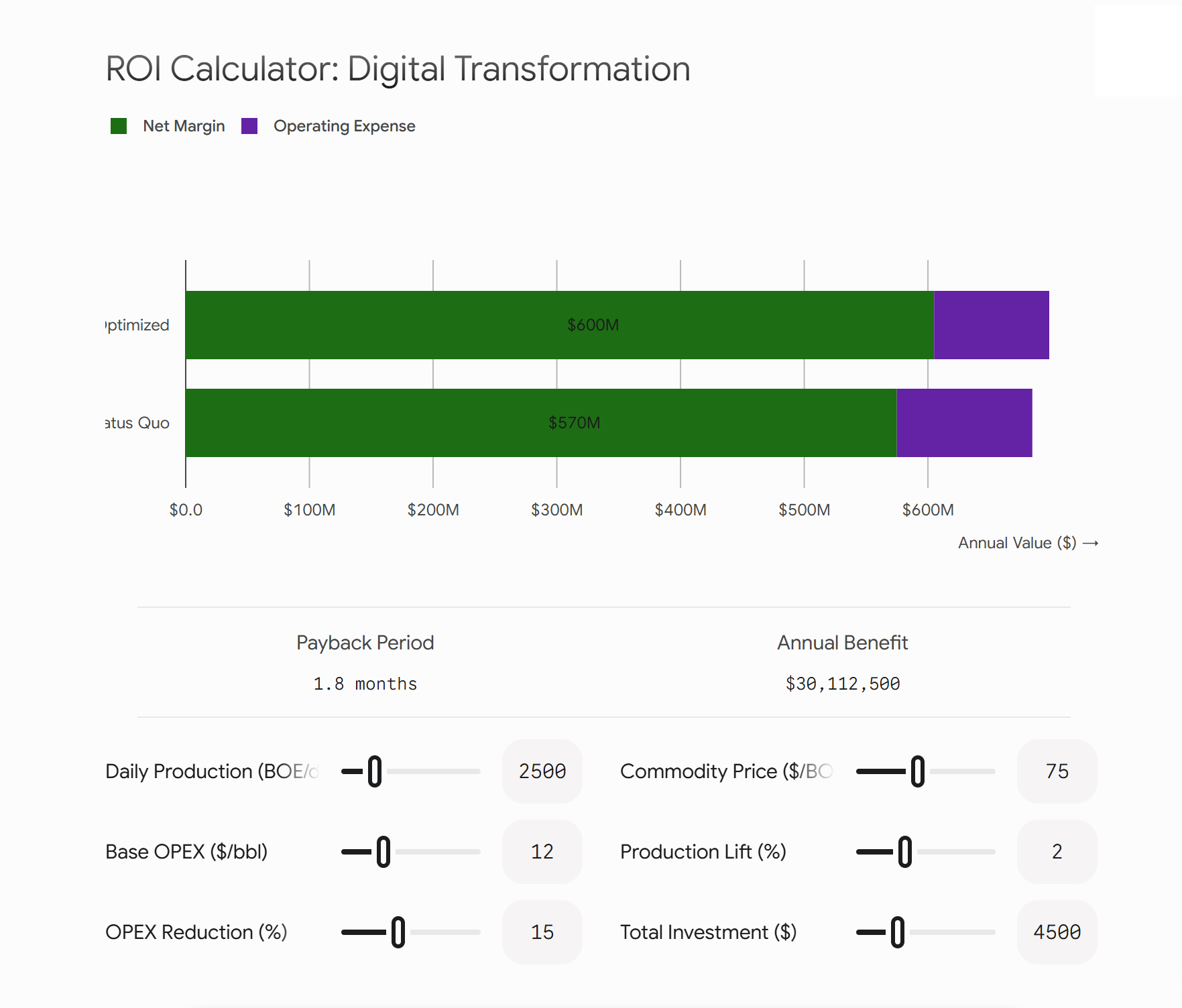
ROI Modeler
The Strategic Justification: Why "Later" is a Competitive Failure
The most dangerous argument against digital deployment is: "We will wait until oil prices stabilize," or "We will include it in next year's budget cycle."
In upstream energy, waiting is a structural disadvantage. Here is why the timing element is critical:
-
The Baseline Problem: Machine learning models and predictive analytics require data history to mature. The sooner your telemetry and automated data ingestion layers are established, the faster your predictive algorithms reach high-confidence thresholds. Delaying implementation delays your asset's intelligence.
-
The Talent Multiplier: The oilfield is facing a severe demographic shift. Experienced field operators are retiring, and taking decades of institutional knowledge with them. Digital systems capture that operational logic, turning tribal knowledge into institutional software code that scales across your entire portfolio.
-
The ESG & Regulatory Mandate: Modern production transformation isn't just about flow rates; it's about compliance. Automated edge-monitoring allows for real-time flare tracking, rapid vapor recovery optimization, and immediate methane leak detection. Proactive digital operators protect their social license to operate; reactive ones pay compounding regulatory fines.
The Path Forward
Digital transformation in the upstream sector is not an IT project—it is a core reservoir and production strategy. It requires moving past siloed organizational structures and investing in open-architecture, interoperable data ecosystems that empower your engineers to make high-velocity, high-impact decisions.
The capital required to implement these systems is rarely "new" money; it is simply recaptured capital that is currently being spent on inefficient field routes, avoidable downtime, and catastrophic equipment failures. For progressive E&P operators, the choice is clear: digitize operations today, or watch your leaner, automated competitors out-produce and out-compete you tomorrow.